
The growing popularity of wideframe Vespa models has created a surge in demand for modern tuning parts. One of the specialists helping these classic scooters cope with today’s roads is Andreas Nagy. Big Chris reports…
Over the last decade, interest in older wideframe Vespa models has gathered real momentum, with both beautifully restored and shabby-chic machines becoming increasingly sought after.

The trend is especially strong on the continent, and Germany has developed a huge following for these distinctive scooters.
Enjoy more Scootering Magazine reading every month.
Click here to subscribe & save.
Old wideframe Vespas are a pleasure to look at and great fun to ride, particularly on quiet back roads or as part of a group where there is safety in numbers. The problem comes when owners want to use them in everyday traffic.
In standard form, many are slow — very slow. There are also the familiar issues of points ignition, limited reliability and poor lighting.
Necessity is the mother of invention, especially when there is a clear demand waiting to be met.
As interest in these classic Vespas increased, several companies began developing upgrades and tuning components aimed at making the beautiful but slow, fat-bottomed machines quicker, easier to start and safer to ride at night.
One of the businesses specialising in these more rotund Vespas is Nagy Blechroller. Founded by Andreas Nagy in 2015, the company is based in Germany, not far from Köln — better known to British visitors as Cologne.
I was fortunate enough to be working in Germany last year and took the opportunity to call in, catch up with Andreas and learn more about the man and the business specialising in the restoration, repair and tuning of classic Vespa scooters.
Herr Nagy
Andreas Nagy is a young 63-year-old, born and raised in Köln, the famous industrial city in north-west Germany.
He got his first Vespa at the age of 15, although he describes it simply as “garbage”. By around 1980, aged 18, he had acquired his first car and was glad to leave scootering behind for a while.
His life on two wheels was put on hold until a change in the law allowed motorists to ride a 125cc machine on a car licence.
Andreas had a background in economics and trained at a bank. He also played in a band that toured as far afield as Russia and Ukraine, even performing at the Kyiv Opera House.
In 1992, Andreas ended up with a Vespa T5. At the time, he admits he knew very little about it and did not particularly like it.
That began to change a couple of months later when he made his first visit to the small garage that would eventually become Scooter-Center.
Andreas says he did not even know how to change a scooter tyre at the time. Thanks to the friendly and helpful advice offered by Oliver and Ulf at Scooter-Center, however, he began learning quickly and became increasingly interested in understanding how scooters worked.



He started tinkering with and repairing his own machines, discovering that they were fascinating and not particularly difficult to understand.
Different parts were tried and lessons were learned through trial and error. Sometimes things worked and sometimes they did not, but it was an enjoyable learning curve and Andreas was steadily gaining valuable experience.
From then on, he became immersed in the scooter scene, attending as many rallies as possible and continuing to learn along the way.
Andreas was also heavily involved with Piaggio Ape three-wheelers and became part of a highly respected club for owners of Vespa-based trikes.
All in
At the time, Andreas was working for an insurance company while repairing and tuning scooters in his spare time.
That changed in 2015, when he was finally able to dedicate himself full-time to his passion for classic scooters and formally established his business.
By 2016, his reputation as a competent engine builder had spread far enough for him to be approached by Pinasco to assist with the development of the company’s tuned wideframe cylinder.
“He was approached by the Pinasco Company to help with the development of its wideframe tuned cylinder.”
Andreas agreed and, a short time later, was handed a cylinder. There was no piston, cylinder head or complete kit — just the cylinder itself.
Undeterred, he sourced a suitable piston and found an appropriate cylinder head to complete the package. With no exhaust available, a tuned PX system was modified to fit.
After many hours of development work, a number of pre-production kits were created and sample engines built.
Once the engines had been completed, it was time to test them on a serious adventure.
Pinasco sent its chief engineer Vittorio Zitun and long-distance Vespa rider Fabio Cofferati to ride the machines to Nordkapp, or North Cape, in Norway — the most northerly point of continental Europe.
The engines proved themselves and the kit was subsequently put into production.
In recognition of the demanding test ride, Pinasco named the new package the Pinasco 160cc Nordkapp kit.
The relationship between Andreas and Pinasco continued to grow and he says that working with the company now feels like being part of the family.
Race, pace, reliability and endurance
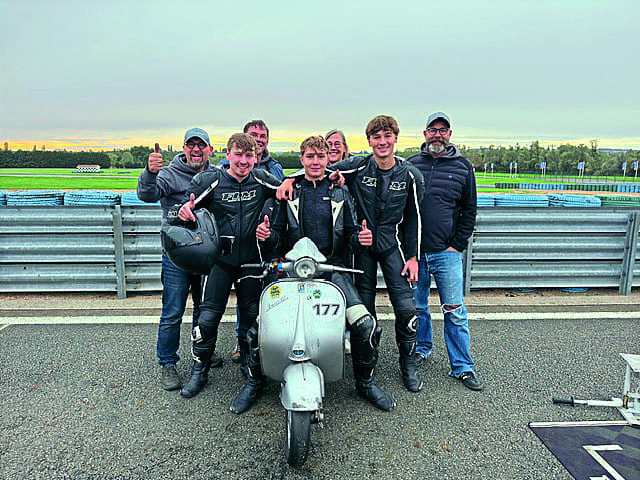
Alongside riding scooters on the road, Andreas supports his sons Julius and Moritz as they compete in classic scooter endurance races across Europe.
The family recently competed at Magny-Cours in France, where the aim was to field the youngest riders on the oldest machinery.
The team finished in a highly respectable 21st place from a field of 54, completing the 10-hour race on a 28hp wideframe Vespa.
Few demonstrations of the strength and reliability of the Nagy family’s work could be more convincing.
A new chapter for Nagy Blechroller
As Andreas approaches official retirement age, he has handed the business over to his son Moritz and is now formally employed by the company.
He remains active, however, and continues to provide advice while sharing the knowledge he has accumulated over decades to help his son guide the business into its next chapter.
Andreas’s expertise was also called upon when Sticky worked with a group of technical specialists to produce an extensive book about Vespa wideframe models.
It is an excellent piece of work by everyone involved, dedicated to making life with a classic fat-bottomed Vespa in the modern world just a little easier.
The Nagy family — Andreas, his wife Ursula and their sons Moritz and Julius — truly are a classic scooter family, taking every opportunity to put road miles beneath their wheels.
They are further proof that the best products and services are usually those driven by genuine passion.
Andreas Nagy, thank you for your time, friendship and enthusiasm.
Words and images: Big Chris

