
No road is impossible…
Stan Bates, the mile-munching scooter journalist and onetime editor of this very publication, has a reputation for not being afraid to take on a long ride in pursuit of his love of scootering, both for work and pleasure. As he is now officially retired, his plans are to continue these small-wheeled adventures whenever and wherever he can. Big Chris reports…

For myself, which would also appear to be the case for Stan, the Vespa PX is the ultimate touring Vespa in classic two-stroke geared trim. It just does the job and gets on with things: good lights, excellent braking and a usually reliable ignition system, but there was always the need for a little more power and top speed from the motor. Now, as most readers are aware, there have been many tuned bolt-on cylinders and other go-faster bits over the years, but many, if not all, of these upgrades giving the power required have been negatively offset by a compromise in the bulletproof reliability of the factory-fitted 200cc lump.
But in the last few years, the engineers at the big-name Italian tuning houses of Malossi, Pinasco et al really do seem to have resolved many of these reliability issues and are producing some fine products to match the robust nature of the Piaggio OEM engines, with the much-needed and sought-after increase in power.
Enjoy more Scootering Magazine reading every month.
Click here to subscribe & save.
Evolution
Stan had previously owned a Spanish P-range Motovespa and had been using the Polini 210cc aluminium touring kit. This was done as a set of features within Scootering to show how it was possible to give decent improvements in power just from bolt-on goodies.
This ran great and covered many miles both within the UK and Europe, but eventually became problematic, blowing holes in pistons. Despite several engine strips with everything checking out OK, the issue was still not cured. Instead, a PX200 from a very well looked-after, low-mileage machine that had been involved in a smash and written off was transplanted.
This also began to hole pistons, which, after further investigation, was found to have been caused by a faulty fuel tap all along. But in the process, Stan was offered a Polini 210 kit, which was duly bolted on and has run since that time, giving a very respectable increase in power and, again, bulletproof reliability, with a gain of approximately 6bhp over standard – all while using the standard genuine Piaggio PX200 exhaust.
The next upgrade was the Polini Box Exhaust, which again found a little more power when correctly jetted. After noticing a bit of clutch slip, Stan opted for the upgraded CR80 plates, which he found to be more than capable of coping with the increased power that the motor was now producing.
The next upgrade was the crank, and again this was down to fate. As Stan was getting ready to ride to Pontedera, he was checking his trusty steed over and noticed a bit of end float on the crank, but was in the right place at the right time to be offered a SIP ‘Premium Sport’ crank to test, so opted for the 60mm long-stroke version with the 110mm con-rod. This now saw the engine become a 221cc unit and, as the carburettor had previously been upgraded to a BGM SI 26/26 Fast Flow version that still runs autolube, all was sweet.
This again recorded a respectable increase in power from just bolt-on bits, taking it to 17.25bhp, with a very rideable scooter. The only mechanical casualty of these performance upgrades was the clutch, but this was quickly resolved with the BGM Superstrong version fitted, along with a 24-tooth primary drive.


All was good with the world
Or was it? Now that the engine was sorted and had been well proven, covering big distances, often flat out on the Super Strada and other main European roads, it was the frame that would now cause concern.
Stan has a habit of giving the vehicles within his household names, and his beloved and faithful travelling companion, Alex – the Spanish Motovespa P-range – had succumbed to frame rot. Now there are some extremely talented fabricators out there who have thankfully brought many a classic Vespa back from the dead, but these are machines where the time, energy and financial implications can be justified by the rarity and potential final value of the machine. The PX, thankfully, is still relatively plentiful, making a replacement the most sensible option for Stan, if not the most pleasant emotionally, as he had to say goodbye to Alex.
Again, the spirit of Enrico Piaggio must have been looking kindly upon Stan and his love for the Vespa, as a well-cared-for PX200 became available at the same time. A test ride secured the deal when Stan could instantly feel how tight his new ride was in comparison to his well-ridden and now very slack and baggy Spanish lady’s body. (Oh, Finbarr Saunders would be proud of me getting that one in, fnarr, fnarr!)
Nulla-via-Invia
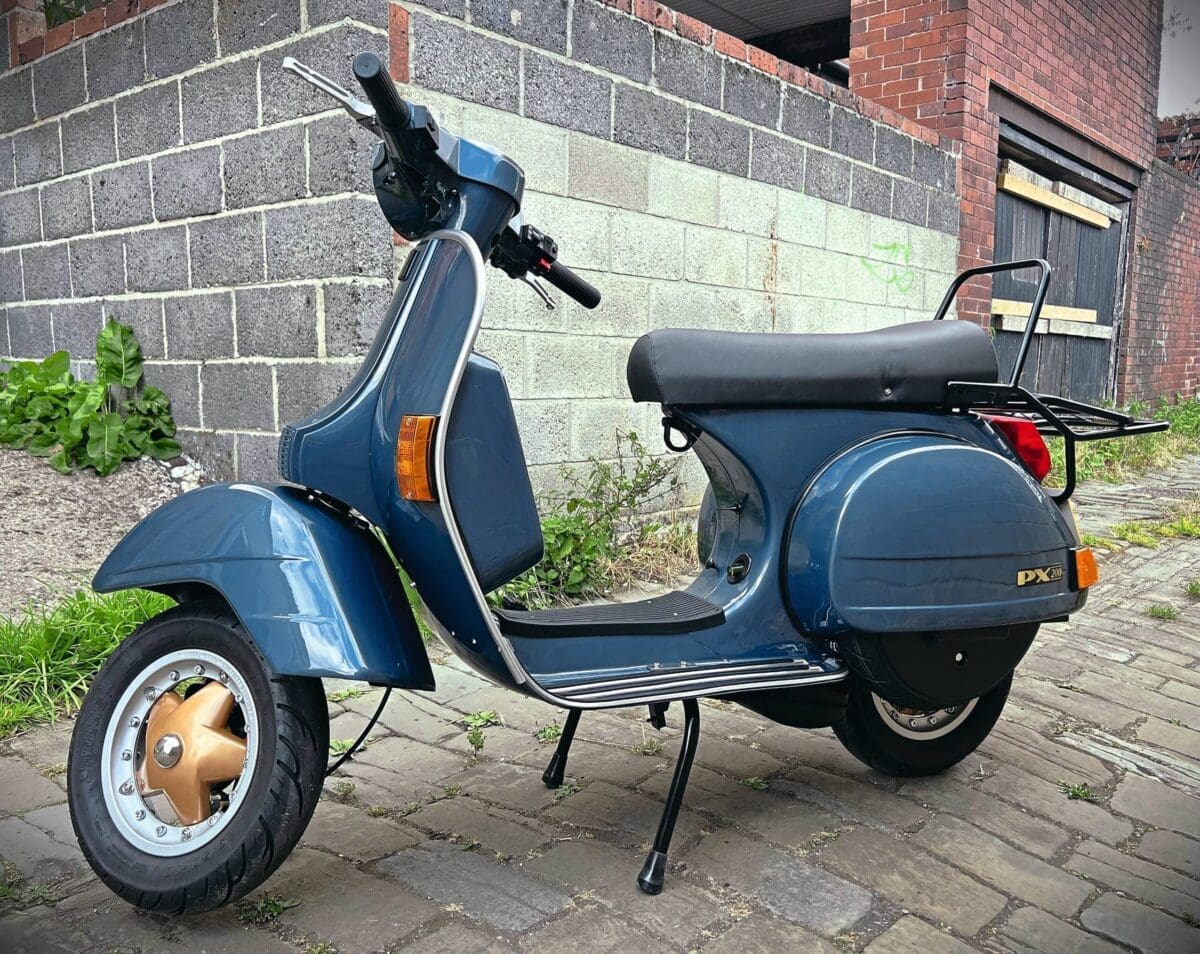
The new machine, now officially named Olivia, was originally white and Stan had no plans to repaint her. But on closer inspection, the previous owner had looked after the frame so well that every little chip, rust spot or scratch had been painted to protect the bare metal beneath. Unfortunately, this was not always with the same official paint-code colour as the rest of the machine, which, despite not being too harsh upon the eye to the man in the street, did begin to bother Stan. Now he could see the differences, he could never unsee them, and that bothered him.
So it was off to see his local scooter spraying specialist, Richard Galloway at Hobnob Racepaint in Barnsley. The colour choice was taken from one of Piaggio’s latest two-wheeled offerings, where they are using their heritage as a strong marketing tool and have produced a limited edition of their present machines named the Officina 8.
Official Piaggio Marketing Quote: “Vespa Officina 8 is designed to commemorate Vespa’s origins, its global success, and the profound importance of the first test center.”
To elaborate on this, with the kind help of Ron Daley’s Scooters: “At Piaggio’s Pontedera plant, a special team was established to create a solution to the country’s need for affordable, reliable transport. It comprised designers, draftsmen, mechanics, master metalworkers and test riders who all worked as a team to achieve this vision. Each of them was specially chosen, all were highly-skilled professionals and many of them had come from the aeronautical industry.
They were officially known as the ‘Officina Sperimentale’ (Experimental Workshop), but to their colleagues they were referred to as ‘Officina 8’, after the office they occupied.
By 1947 the team moved to larger premises on the site and were granted use of the very latest in industrial machinery. Even this wasn’t enough to contain their aspirations and in 1952 the team relocated to a nearby racetrack where they could continue their arduous testing regime. Access to the team’s offices and workshops was tightly controlled, but if their working conditions were secret, their results would become world famous. It was from the imagination of the Officina 8 technicians that the Siluro Vespa 125, which set 17 world speed and endurance records in 1950, and a flying kilometre record of 171km/h (106mph) in 1951 would emerge. Other machines, many of which can be found in the Piaggio Foundation’s Museum, such as the legendary ‘98 Corsa’, and the scooters that dominated the arduous International Six Days Trial of 1951 are just a few of the masterpieces created in Officina 8.”
Identity
Stan, with the help of Michael Daley at Ron Daley’s Scooters, managed to get Piaggio to release one of the official Officina 8 badges that can be seen on the bottom left of the toolbox door with the quote Nulla-via-Invia. Although they would not release the official paint code, Stan got a good match, which is actually Land Rover Tasman Blue and looks gorgeous in gloss rather than the matt/satin finish Piaggio are using. The subtle gold accents here and there lend themselves perfectly to the main colour, and a special one-off PX side-panel badge just adds the cherry on the top. The Madrid rack is very practical and cool-looking, and the registration VSX is the first three letters of the prefix for the frame and engine of a PX.
Chocks Away
The signwriting was undertaken by Lloyd’s Kustom Art from the Isle of Wight and is taken from another passion of Stan’s: aviation history. As he was trying to come up with a theme, Stan became aware of a project that had recreated a First World War Caproni bomber in Italy. The replica had been finished in the scheme of an aircraft flown by Maurizio Pagliano and Luigi Gori. They were pioneers of long-distance flight and their aircraft carried the inscription ‘Nulla-via-Invia’. That translates as ‘No road is impossible’, which Stan says sums up his approach to Vespa touring.
I can imagine that, after recently becoming a man of leisure, Stan will set off to prove the quote to its utmost and test both man and machine to the limits. Nice one, Brother. Enjoy!
Words: BigChris!
Thanks to: Stan and Ron Daley’s Scooters


