
There have been many great Lambretta race engines used on the track, but what about creating a road-going version? Stu Owen reports…
There is no denying that the scooter racing scene in the 1980s saw huge development of the Lambretta engine. Anything from pistons to cranks, exhausts to ignition systems, and much of it made its way into road-going engines. Any form of motorsport, whether it’s Formula One or MotoGP, is a test bed for manufacturers to develop their products in the same way, but on an industrial scale. They don’t spend millions each year not to do something with the technological advancements they create; they use them in the vehicles we commute in.
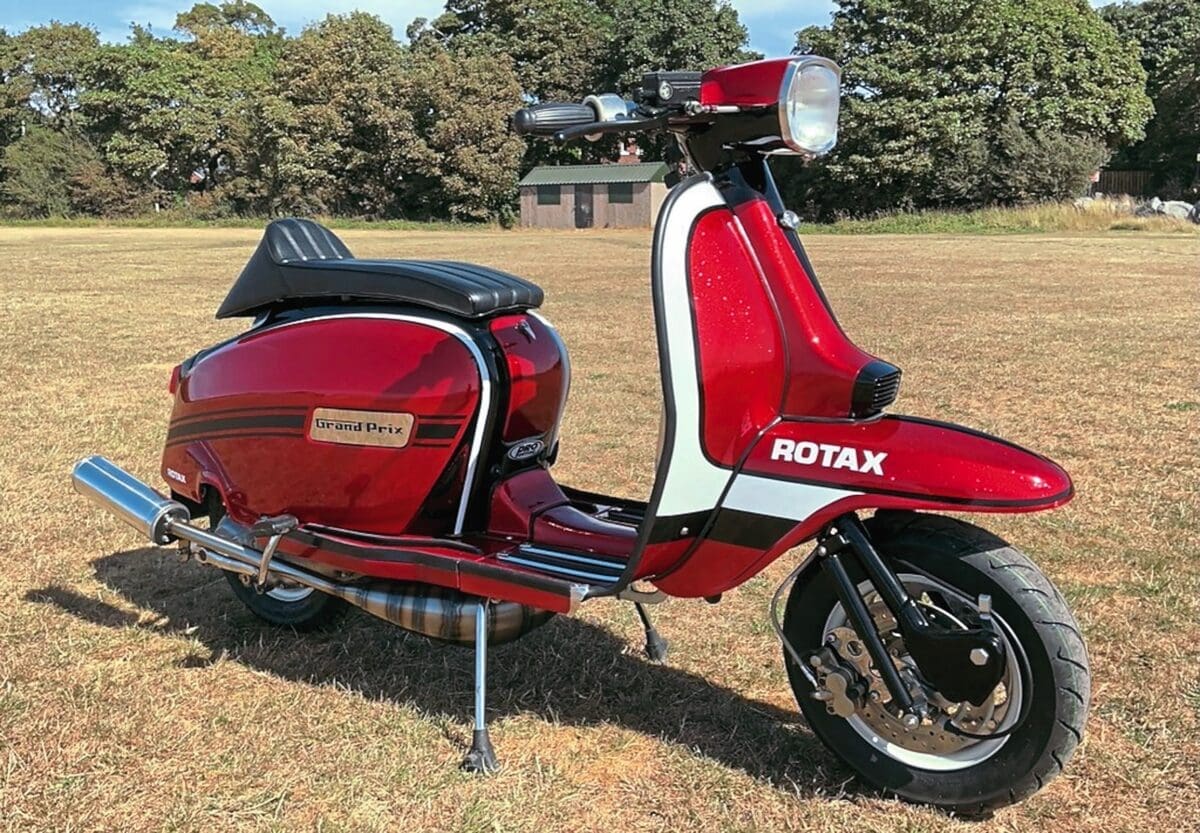
The problem with a Lambretta race engine is that the owner or shop doesn’t have the same kind of budget and therefore can’t produce it for road use. The odd component, as already mentioned, has made it, but a complete engine is much more difficult. Casa Performance have come the closest to achieving commercial race-to-road engines, but even they had to rein in the big money they spent doing so with their race team a few years back. However, one Lambretta racer has done so and with one of the biggest engines of all.
Enjoy more Scootering Magazine reading every month.
Click here to subscribe & save.
Wait a few years, please
Last year we wrote about the exploits of Stephen Holt and his career in Lambretta sprinting. It had been a long road of development, with many ups and downs, but achieving 97mph over the eighth of a mile from a standing start showed how successful he has been. Stephen did most of the work himself, building up the whole chassis from scratch. This included the engine, which is central to what he has achieved and, due to its complex nature, has been the biggest challenge by far. It’s based on the Rotax snowmobile cylinder, and as we reported, it took a long time to get it off the bench.

During the chats we had while working on the article, Stephen informed me that the plan was to produce a road-going version of the sprinter. Slightly confused, did he mean the whole machine? Of course not, as anyone who has sprinted a Lambretta will tell you, they are the most uncomfortable things at the best of times. He was referring to taking the engine specification used on the track and putting it into a road-going Lambretta. There would be some compromises, such as the huge forward-facing expansion pipe, for example, but otherwise it would be a similar spec.
It was a big claim to make because a Lambretta Sprint engine most likely covers less than 100 miles even in a competitive season. Now you’re going to take a highly tuned engine for race use and clock up thousands of miles on it on the road each year. Stephen has done all the work himself, though, so he knows its weak points or where the engine needs strengthening. He has developed it over several years and knows the thing inside out, so he has had plenty of time to iron out any teething problems. A race engine needs to be bulletproof because it’s no good having reliability issues at every meeting. So if anything, it’s over-engineered to prevent this from happening, a philosophy used in motorsport in general. Remember the old days: an F1 car with a huge plume of smoke trailing it like a rocket was to be expected, and cars couldn’t manage one race. These days, it’s a rare sight, and when it does, it’s shocking that such a thing should occur. His school of thought is the same, and he has proven it is possible to take an engine from the track to the road without reliability issues.

Exhausting
The one advantage Stephen does have is with the casing being used. Originally, it was hours and hours of trying to weld up a traditional Lambretta casing so the large Rotax cylinder would fit. Okay, if you are doing a one-off for racing, but impractical otherwise. Thankfully, Richard Taylor’s GT casing came to the rescue, allowing the cylinder to fit straight on with no modifications. So once the basic layout of components for the sprint engine was confirmed, these could be used for the road version.
Components
- GT engine casing
- Rotax 617 snowmobile cylinder
- Pro Porting 66mm-stroke crank
- Mikuni 38mm carburettor
- Pro Porting prototype race pipe
- CasaTronic ignition system
- Pro Porting six-spring race clutch
- SX200 gearbox with 17/46 sprockets
The cylinder runs 133 degrees of timing on the transfers and 200 on the exhaust when fully open. That is because it uses a RAVE valve. No, it doesn’t mean it takes pills and goes all night dancing in a disused warehouse. RAVE stands for “Rotax Adjustable Variable Exhaust”. A bit like the Yamaha power valve system, and we all know how good that was. The advantage of this is that it gives the engine good tractability at low revs, for instance, when riding around town. As you increase the revs under acceleration, the valve opens up at around 6,000rpm, and the additional exhaust timing allows the engine to make good power. Stephen reckons this is up to around 8,800rpm, where the peak power is.


Therefore, it can be as tame as you like when riding around the streets and traffic, but a beast once you open it up on the road. As with all two-stroke engines, the exhaust is the main factor determining power delivery. That’s why it took some thinking in its design. It was easy on the sprint bike, as big and as wide as you like, pointing in whatever direction you desire. Now it had to fit on a full-bodied Lambretta with side panels and footboards, meaning a lot of thought had to go into it. The problem is that making it fit can mean compromising on the mid-section diameter, for instance, and losing a lot of power. He worked closely with Harry Barlow on this and, once it was perfected, did a little fettling of the mounting brackets.
Radiating
Just when you think you have sorted everything and got the engine to fit perfectly, along comes the next problem, and it’s a big one: the dreaded water cooling. The reason Innocenti didn’t attempt it was that the Lambretta’s compact design left no room to fit the system. Many have tried it, certainly post-TS1 days, but it’s never a pretty sight. Stephen had no choice because that’s the way the Rotax cylinder comes. Again, piss easy to do on the sprint bike where anything goes, but trying to fit it under the Lambretta bodywork was the challenge. To compound it further, the Rotax cylinder needs a large radiator to cool it, so the final resting place was behind the leg shields.
Strangely, the large cylinder fits without any modification, but you have to remember there are no cowlings so it comes in around the same dimensions as a standard barrel with them fitted. The carburettor sits behind the right-hand side engine mount, where there is a nice gap, but it does require a different cut-out for the petrol tank, obviously. If that’s the sum total of shoving such a huge engine into a small space, then it’s not too much to worry about.
However, Stephen had the knowledge to realise it was possible in the first place, and that was the clever thing here.
There are no exaggerated side panel cutouts required, daft bridge pieces that don’t look right or complete removal of the footboards. Looking at it from the side or any angle, for that matter, it looks like a normal Lambretta with an expansion pipe on. That’s where the skill comes into play, producing a monster engine with huge power but, from the outside, totally standard in its appearance. That’s why this concept is a winner: to achieve it, nothing cosmetic has to change. Okay, there is a radiator, but a better way to put it is that there are no structural changes to the frame or anything like that, so it’s reversible if you want to revert to standard.
Forty-five and still alive
So we know the engine build is fairly straightforward, thanks to the use of the GT casings, the cylinder, and everything else that goes with it. We also know that, without too much modification and with a little fettling, the engine goes into the frame without any fuss. This is important because it means the balance Innocenti created remains intact and doesn’t raise any handling issues. The question now is: what does it go like? That was something I was waiting to find out and only got the results the day this article was being signed off.
They were worth the wait, though, because the graph sent over confirmed that this engine is a beast: at 9,000rpm, it’s just touching 45bhp, with a smooth torque curve peaking at 26lb-ft. Looking at the graph, you may think something is wrong because a normal Lambretta graph has a smoother curve. This one clearly shows how the exhaust valve comes in. Stephen told me that, on this run, the throttle was fed in progressively at low revs rather than opened wide, but you can see that at 6,000rpm it is reading 20bhp before literally taking off as the valve opens.
What this means is that, around town, as long as you aren’t throttle-happy, you can ride it like a normally tuned Lambretta, but if you want to open it up, it becomes a race engine. It also means you don’t need to keep changing down gear to get into the power-band; you just wind the throttle on in fourth gear, for instance, and the valve does the work. You can also see the valve starts operating at 6,000rpm because that’s where Stephen likes it to start. However, it can be adjusted quite easily, so you could have it come in lower, at, say, 5,000rpm, or later, at 7,000rpm. This translates to a very easy-to-ride machine that doesn’t need to rev hard to access its power, unlike many tuned Lambretta engines. The advantage of this is that it’s very rideable around town or in a group, and it doesn’t put unnecessary strain on the transmission, thereby increasing the reliability of a huge, powerful engine.
Stephen has put a lot of thought into this project, but remember it comes from years of perfecting it on the track. That’s the advantage: he has the ideal situation from which to test it and learn about it—fine-tuning its development before putting it into a road-going Lambretta. The one you see here will be off to pastures new as it’s being sold. While I don’t think he has plans to set up a huge production line for them, I believe more are in the pipeline. Regardless, it’s a huge achievement and a testament to his hard work and skill. Hopefully one day I will get the chance to find out for myself, as Stephen has invited me to try it out. One thing is for sure: I’m looking forward to seeing how it goes once that needle hits 6,000rpm.
Words: Stuart Owen
Images: Stephen Holt and Paul Fishwick Photography


