
Practical Scootering: In the garage, with Dan Clare
Peak horsepower isn’t everything: two very different dyno sessions show why the right power delivery and a safe set-up matter more than bragging rights, while Rhodz explains how to adjust tyre pressures for two-up touring.

I probably sound like a stuck record sometimes, but one thing I keep banging on about with dyno testing is that peak bhp isn’t everything. Yes, everyone likes a big number at the end of a graph, me included, but what actually matters is whether the engine does the job it was built to do. And this month we had a perfect example when Ben Ward brought a Lambretta in for testing. Ben had built the engine for a customer who wasn’t interested in owning a screaming 30bhp monster; he wanted a touring engine. A proper mile-muncher that could sit between 50–60mph all day without needing its neck wringing, but with enough in reserve to push on and overtake if required.
Ben used a BGM 195 cylinder kit with a 60mm GT crank, 30mm PHBH-style carburettor and SIP box pipe. Nothing particularly outrageous there, but the interesting part was the gearbox. Rather than simply using a standard Lambretta gearbox, Ben had fitted a custom four-speed close-ratio set-up from Chiselspeed, including a bespoke third/fourth gear combination designed to keep the engine within its useful powerband as it works its way through the gears. And the dyno demonstrated exactly what that achieves.
Enjoy more Scootering Magazine reading every month.
Click here to subscribe & save.
We did a run through all four gears, which produces a graph looking rather like a row of increasingly large hills as I accelerate through each ratio. But it gives a really useful visual demonstration of how the gearbox works. Instead of each gear change dropping the engine miles away from where it wants to be, the closer ratios allow it to pick straight back up and continue accelerating.
Third gear was then tested separately to get a clearer picture of the actual power and torque curves. Peak power was around 16.5bhp, accompanied by approximately 15.5ft-lb of torque. Those aren’t numbers that will have the Facebook horsepower warriors choking on their cornflakes, but that completely misses the point. Look at the shape of the curves instead.

Both power and torque build progressively, with the torque arriving early and remaining useful across a wide rev range. Power peaks just under 6000rpm, but importantly it doesn’t immediately fall off a cliff afterwards. There’s some useful over-rev available, which means that when the owner wants to push past his normal cruising speed to overtake something, he isn’t immediately running into a brick wall.
For the intended job, that’s exactly what we wanted to see… a well-built engine making a broad 16–17-ish horsepower, combined with intelligently chosen gearing, can make a cracking road scooter. It’ll comfortably sit at realistic touring speeds without constantly being thrashed, while the close third and fourth ratios help keep it on song when the road starts going uphill or you need to get past something. Job done.

Peace of mind
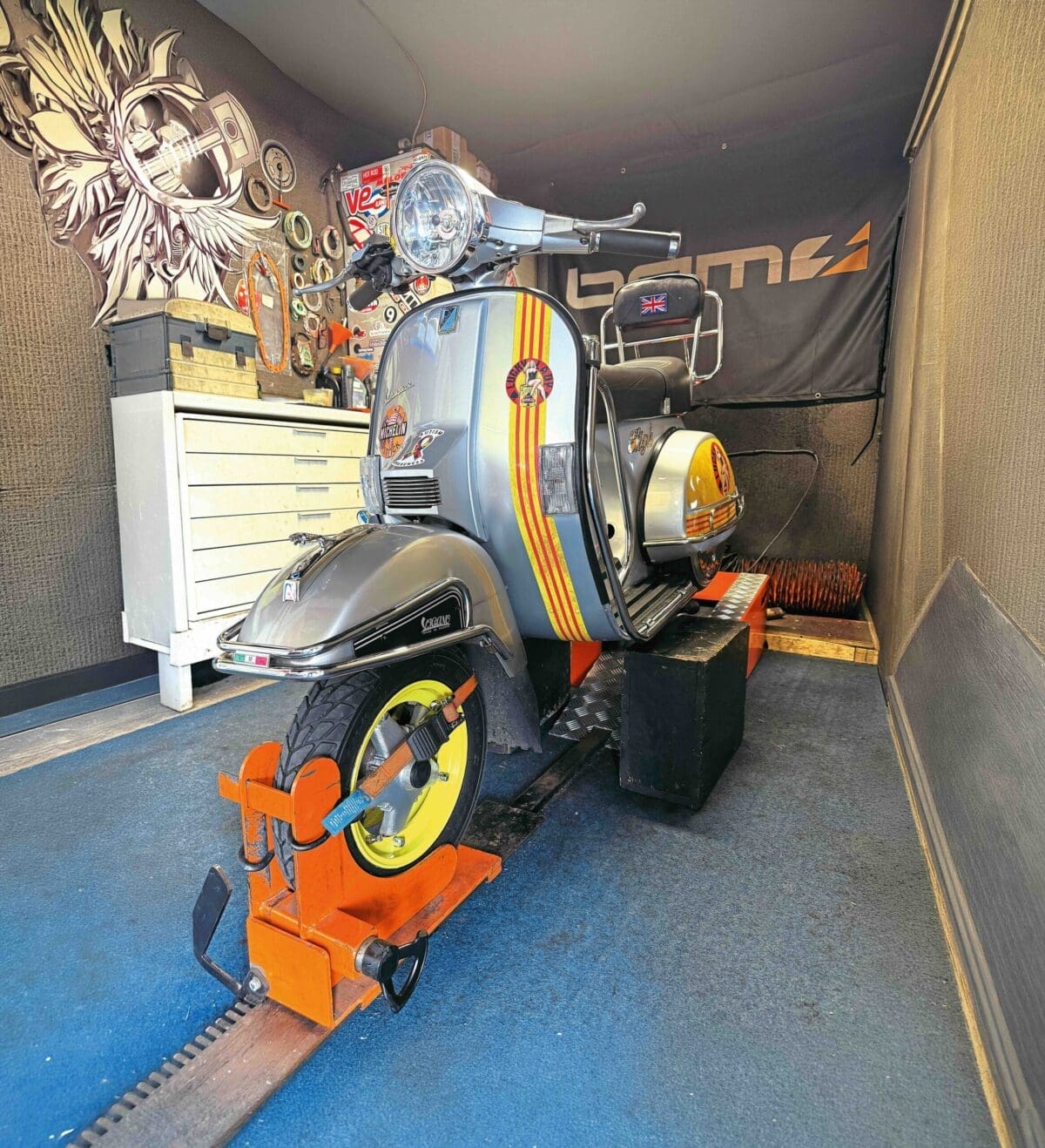
The other scooter this month illustrated another reason why I think dyno testing is worthwhile. The owner arrived with a lovely Vespa fitted with a JL right-hand expansion chamber. There wasn’t some enormous problem to solve and he wasn’t chasing another five horsepower; he simply wanted the scooter checked over and the reassurance that everything was safe. Sometimes that peace of mind is worth just as much as finding extra power.
The dyno showed that the carburation was slightly lean on the pilot circuit, so we increased the pilot jet and richened the mixture-screw setting accordingly. Nothing dramatic, but enough to get the fuelling where I wanted it. More importantly, we checked the ignition timing.
It was set at approximately 23 degrees BTDC. That’s far more advance than I’d be comfortable running on a scooter using today’s crappy fuel, particularly one that’s potentially going to spend extended periods under load. We reset it to a much safer 18 degrees BTDC.


Again, there was no massive horsepower revelation and no heroic dyno number to boast about afterwards. But that’s not what the customer came for. He arrived wanting to know that his scooter was set up correctly. He left with the carburation corrected, ignition timing put somewhere considerably safer and the confidence that he can now get out and enjoy riding it.
Two scooters, two completely different jobs, but arguably two good examples of what a dyno should actually be used for. It’s not always about finding the biggest number. Sometimes it’s simply about making the scooter better at doing whatever its owner built it to do.
That’s all from me for now; let’s see what next month brings… stay tuned.
Words & photos: Dan Clare


