
Keeping it Classic
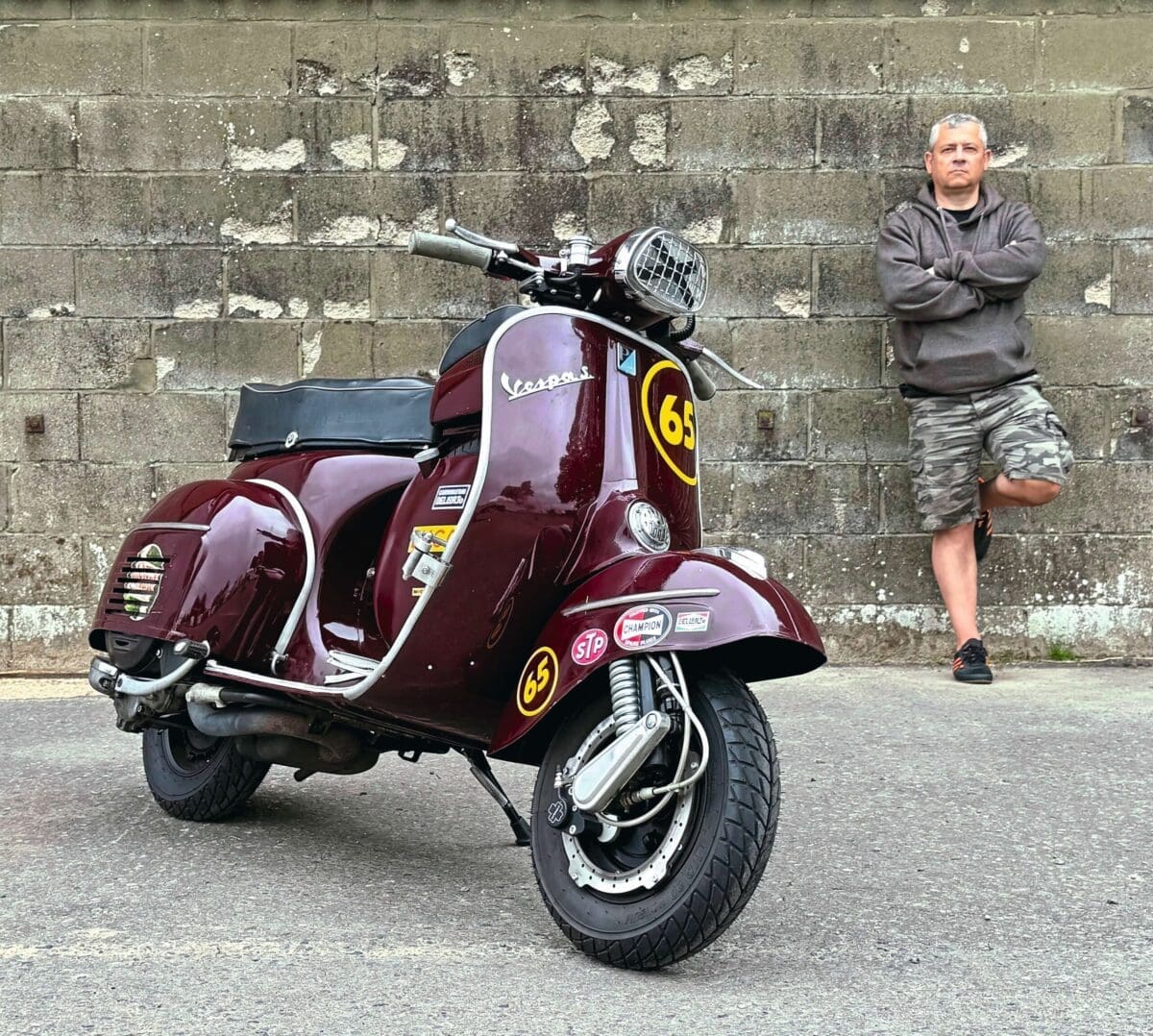
Inspired by the café-racer era and built with careful planning, Steve Stringer’s 1965 Vespa 150 Sprint captures the spirit of the 1960s while blending classic style with modern engineering. So we asked Stu Smith to find out more from Steve Stringer.
Sc: How did your scootering journey begin?
Enjoy more Scootering Magazine reading every month.
Click here to subscribe & save.
SS: Like a lot of people, it all started with Quadrophenia. I watched it in my early teens and was completely taken with the scooters and the whole scene. Around where I lived, the older lads were riding Vespas and Lambrettas, so the film simply reinforced what I was already seeing. From then on, I knew I wanted one of my own. When I turned 16, I bought an original blue Vespa 90 from a mate, and that was the scooter that really got me into the scene.
Sc: Your dad was into motorcycles. What did he think when a scooter turned up?
SS: My dad had always ridden British motorcycles during the 1950s and ’60s. I remember him owning a Velocette 500, and my brother also rode motorbikes. Two wheels definitely ran in the family, but scooters weren’t part of the picture, so my dad probably wished I’d watched Rebel Without a Cause rather than Quadrophenia.

The first thing he said when he saw the scooter was, “What the bloody hell have you got there?!” Then, as he started looking it over and realised I was only 16, he spotted the ’90’ badge. I quickly told him it wasn’t really a 90cc and that it was basically just a 50 because it didn’t go very fast. I don’t think he was convinced, but I gave it a good try.
Sc: What happened after that first scooter?
SS: Once I’d passed my test, I bought a PX200, which became my rally scooter throughout the 1980s. It was reliable, comfortable and exactly what I wanted for covering miles with my mates.
I sold the Vespa 90 to my good friend Earl, and we got the jigsaw out and turned it into a chop. Earl built a nice custom from it, but when you think about it now, we cut up what was a lovely original V90. At the time, though, everyone was doing it.
Sc: What’s your most memorable rally?
SS: One trip always sticks in my mind. Earl’s brother had just joined the Army, so we borrowed his brand-new P200 and rode it two-up from Kent to Morecambe and back. It was well over 300 miles each way, so his scooter certainly got a proper running-in. Later the same year we also rode it to Margate.
Sc: Why did you choose this scooter for the project?
SS: I bought it in the spring of 2023 and it was fitted with a Vespa T5 Mk1 engine. It was complete, solid and already painted in the Morris Minor maroon that it’s still got today. At the time I already had a few other projects on the go, so I deliberately wanted something that wasn’t going to involve too much work. Importantly, the paint suited the theme I had in mind, so rather than repainting it, I decided to build around the colour. The aim from the beginning was to create something that looked like a period café-racer rather than a heavily customised scooter.


Sc: The styling looks very authentic. How did you achieve that?
SS: Dave at Atoms was a huge help throughout the build. He sourced the parts, offered advice and helped develop ideas that would work and support the project.
One of the first components I bought was the Crimaz front disc brake conversion kit with an outboard old-style hydraulic reservoir. Visually it suits the era perfectly and it’s also a clever setup because it allows you to retain the original 1960s-style front spring while benefiting from modern braking and improved suspension. Together with the Crimaz hub, upgraded Stoffi spring and BGM damper, it keeps the classic appearance while transforming the way the front end responds. The balance between period looks and modern usability was exactly what I was trying to create throughout the build.
Sc: You’ve added a lot of specialised features around the scooter. Tell me about those?
SS: The dummy Vespa SS90 fuel tank is actually a toolbox and, when you lift up the chest pad there’s plenty of room inside for tools and any other bits you want to carry. However, adding the dummy tank created a problem because it prevented the original seat opening on its front hinge. Dave came up with the solution by designing and fabricating a new rear-mounted hinge, so the seat now lifts from the back instead. It’s one of those modifications that most people never notice, but without it the idea wouldn’t have worked. Another important detail that helps deliver the café-racer theme was relocating the spare wheel. Instead of sitting flat against the legshields, I moved it so that it now sits beneath the dummy tank, in line with the footboard runners. Inside the spare wheel is also a Vespa GS auxiliary fuel tank, which provides another period-inspired touch and helps reinforce the overall look.
Sc: Tell me about the graphics and stickers around the scooter?
SS: I wanted to keep things minimal, so I added the ’65’ stickers to link in with the scooter’s year of manufacture. I’ve also added a selection of stickers from runs and rallies I’ve attended over the years, and together they help tell the story of the scooter without overpowering its overall look.
Sc: What’s it like to ride?
SS: Solid and responsive. I’ve kept the Mk1 T5 engine standard apart from up-jetting the carb to suit the SIP Road 3 exhaust. Where the scooter really comes alive, though, is at the front end. The hydraulic disc brake inspires confidence and, combined with the upgraded suspension, there’s very little front-end dive. It feels composed without losing the character of a classic Vespa, and it’s exactly how I hoped it would ride when I first started planning the build.
Sc: Was there anything particularly challenging during the build, and who would you like to thank?
SS: The hardest part was setting up and bleeding the hydraulic front brake properly because it’s something you have to get absolutely right. Once it was done, though, it was worth all the effort.
I’d especially like to thank Dave at Atoms for sourcing the parts, sharing his knowledge and fabricating the rear seat hinge that solved a genuine engineering problem.
I’d also like to thank everyone at West Malling Spitfires S.C. They’re a fantastic group of mates, and we’ve had countless laughs together on rallies and scooter trips both in the UK and overseas. As we always say, it’s ‘always an adventure’.
Stu says: Steve’s scooter is proof that the best customs don’t always have to shout the loudest. By resisting the temptation to repaint or over-modify it, he has created a machine that captures the spirit of a mid-1960s café-racer. Every detail works together, making it feel as though it could have been built during the era that inspired it, which was exactly the goal from the outset.
Words & Photos: Stu Smith
Man and machine
Name: Steve Stringer
Scooter club & town: West Malling Spitfires S.C., Larkfield, Kent.
Scooter model: 1965 Vespa 150 Sprint.
When purchased: Spring 2023, bought as a standard machine with a T5 Mk1 engine fitted.
Engine: Standard T5 Mk1.
Carb: Standard T5 Mk1 up-jetted.
Exhaust: SIP Road 3.


