
The centrepiece of the motorcycle industry, the annual Earls Court show prompted a Lambretta special. One so profound it still has an influence today. Stu Owen reports…
1937 saw the first International Cycle and Motorcycle Show at Earls Court in London. Located in the borough of Kensington, it would become an annual event until the show was relocated in the mid-1970s. It became the world’s centrepiece for the motorcycle industry and, in the post-war two-wheeled boom, was of the utmost importance for all manufacturers. In the days before you could see a press release with a click of a button, the annual two-week event held in November was the only place to see what new machines would be on offer the following year.
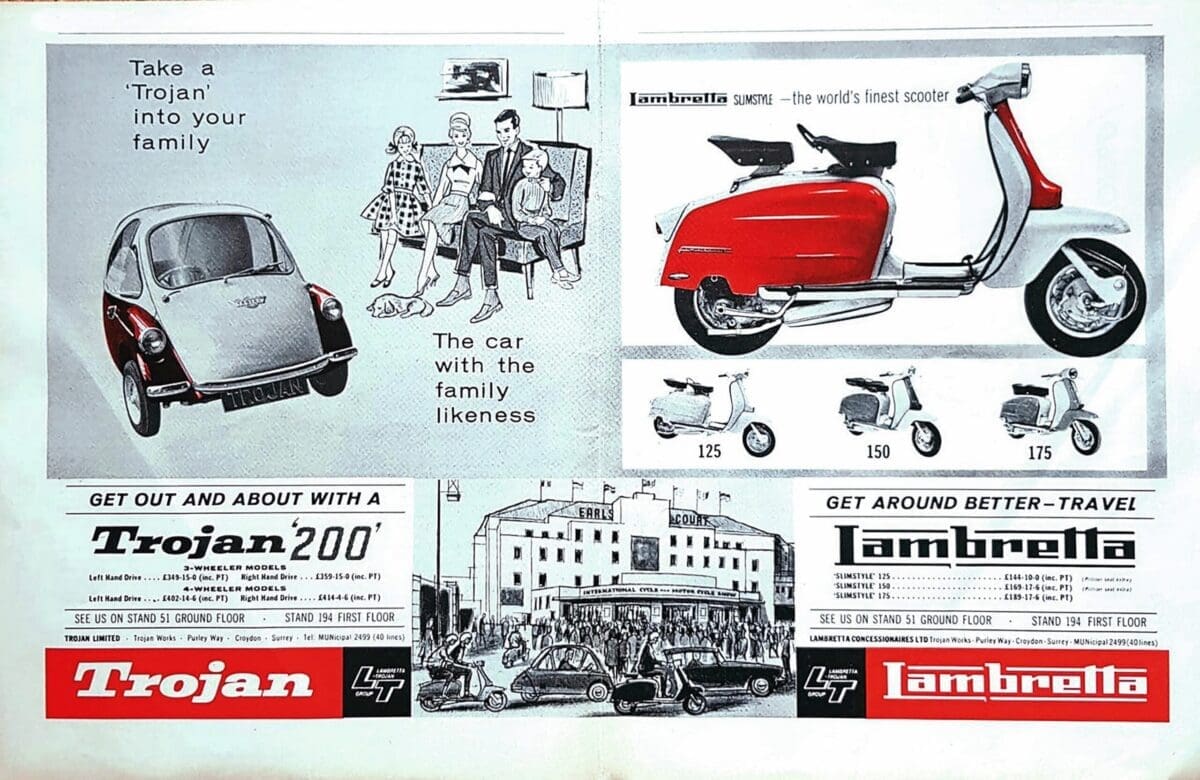
That’s why it was so important to be there: not only to showcase a current model range, but also to give a sneak preview of what was in the pipeline in terms of the latest developments. Manufacturers would have huge stands and fill them with every model currently available in an attempt to woo customers. Rightly so, because the public would flock in their thousands to see what was on offer, potentially ordering a new machine in advance for the start of the next sales season, which was only weeks away. It became the biggest event on the calendar, and each year it would grow as manufacturers tried to outdo each other.
Enjoy more Scootering Magazine reading every month.
Click here to subscribe & save.
See you there
Lambretta Concessionaires were the market leaders when it came to advertising, and that was one of the reasons why they were selling so many. Owner Peter Agg would grasp any opportunity to promote the Lambretta, so understandably the Earls Court show was important to him. From the early days of the 1950s, when they were selling the LD, the company stand would be a huge centrepiece. Peter himself, along with the sales staff, would take the opportunity to speak to the public directly, and by being present, he felt they were connecting with customers.

Dealers were also invited to be present on the stand, and because it was so prestigious to be there, it was always oversubscribed. There was no preferential treatment for big city dealers over more rural ones, and all were put in a draw for the allotted places. As the show moved into the 1960s, it began to change, as this was the decade when quick-fire sensationalism and gimmicks made the headlines. No more mundane sales talk of cheap-to-run machines and great weatherproofing. This was the era where speed sold, as shown by the likes of Triumph and B.S.A. They would litter their stands with factory race machines and the riders who took them to success at the likes of the Isle of Man TT.
The Lambretta couldn’t offer such claims and never would, as Lambretta racing in the UK didn’t exist in the early 1960s. However, with the launch of the TV 175 series three in 1962, it had something no other manufacturer could claim: a fully operational front disc brake. It was a huge revelation at the time and something Peter Agg was more than happy to boast about. Forget rival scooter manufacturers; he could scoff at the big motorcycle players of the industry, offering something that they didn’t have. It was all well and good turning up with the flagship model, but in true Peter Agg fashion, he wanted to take it even further and came up with the idea of the “Earls Court Show Replica”.
It was nothing grand, like upgraded engine performance, added accessories, or anything like that; it was just a different paint scheme. He referred to it as streamlining the “Slimstyle”, which Innocenti had named the Series Three range when they launched it that year. If this wasn’t confusing enough, he labelled the Li 150 version the “Widestyle”, whatever that meant was anyone’s guess. The TV 175 was already available in a two-tone colour scheme direct from Innocenti. It featured not only a different colour on the side panels but also the headset top and bottom, horn casting and front mudguard.
The “V” line down the centre of the horn casting was picked out in white, as was the line on the top of the front mudguard. Meanwhile, the side panels which featured a raised centre band as standard would have two flashes again in white added. The one at the top was described as a wide-line flash and the one below as a narrow-line flash, dramatically raising the profile of the panel stripe. There was an additional cost of £2 10s for the privilege, but it was hoped dealers would take up the offer of promoting it. This would be done with an Earls Court display if their showroom was big enough. It was another clever ploy Lambretta Concessionaires had come up with to sell more machines, but if it worked, then why not.
I will have that one, please
Charles Hall lived in King’s Lynn and had owned a Lambretta Li 150 for a few years. He had been more than happy with it but felt it was time for an upgrade. Like many who had owned a Lambretta, he wanted to stay loyal to the brand, so went to his local dealer to do a part exchange. The dealer was Peter Guest Ltd, and part exchanging was commonplace in those days, but what would he replace the ageing Li with? This was 1963, the new Slimstyle range was well established and the top model was the TV 175; however, the one the dealer had on display was no ordinary one, but the one used at the Earls Court show from the previous November.


Charles was not only interested but impressed by its different colour scheme and agreed to purchase it; however, there were conditions. Lambretta Concessionaires insisted it be on show for several months before the dealer was allowed to sell it. This was understandable, as they wanted to get as much publicity from it as possible before moving it on. That meant Charles wouldn’t get his hands on it until March, but he didn’t mind the wait. Luckily, it was a couple of months before the TV 200 made its debut; otherwise, he might have changed his mind and opted for the even more powerful model.
Finished in the factory white with the lilac option and the Earls Court scheme, it took pride of place in his garage. However nice it might be, this Lambretta wasn’t going to be mollycoddled; quite the opposite, it was used daily for work and commuting around town, clocking up the miles in the process. Even so, Charles looked after it regularly, cleaning and maintaining it not so much because it was special, but because he looked after his possessions. To him, it was just a Lambretta with a nice paint scheme; he never thought of it as anything else.
The Lambretta was taken further afield into Europe on several occasions, to France and Belgium, performing flawlessly, but all that changed in 1967. That was the year his son Ian was born, and now the family had grown; the Lambretta wasn’t enough; they needed a car for transport. However, this time there was no trade-in; the car dealer probably would have taken the Lambretta, but it wasn’t sold to fund the car either. Instead, it was taken off the road, which was rather sad, but with no use for general transport, it was understandable, as it would incur extra costs to keep it on the road.
Daylight again
That was always the problem with a Lambretta Series Three; its nice compact design meant it was easy to put in the shed down the garden and forget about it. That happened to the TV 175 in 1967, but thankfully it was stored in nice, dry conditions, which was a good job because it didn’t see daylight again until 1983. After a 16-year sabbatical, Charles decided to get it back on the road again. That wasn’t as straightforward as it might seem because during the intervening years the old logbook hadn’t been updated and the new V5 style had been introduced.
The process of getting it re-registered was undertaken, and thankfully the original number was allowed to be kept. The only downside was that the original green card logbook was handed over to the DVLA as proof, but despite asking for it back, it was never returned. Now road-legal, Charles started using it locally, but things had changed dramatically. Since it was last used, Innocenti had stopped production, and by now Lambrettas were becoming rare commodities. The scooter boy era was in full swing, and he would often be followed and then stopped by those wishing to buy it from him. He refused all offers; it wasn’t about the money, as the scooter was part of the family and had sentimental value.
Age was creeping up on Charles, certainly regarding his Lambretta riding days, and the inevitable finally happened when he stopped using it. So what next? The answer was the family, and his son Ian would now be the one to look after it. It was a natural progression which would see him maintain it, putting it through a yearly MOT until it became exempt, and insuring it so it could be used. That said, it doesn’t go out much; according to Ian, it covers about 20 miles a year. That doesn’t matter because it doesn’t need to be out on the road every day; ensuring its existence is the most important fact here.
One of a kind
One of the things you could guarantee with Lambretta Concessionaires was that they would promote the hell out of the Lambretta in any way they could. Unfortunately, they were not so good at keeping records, so when something like the Earls Court Show model was introduced, it is not clear how many were done. It was quoted in the press release that there were over 600 orders, but knowing how the company worked, that had to be taken with a pinch of salt. It must also be remembered that this was done across the whole model range, including the Li 125 and 150, not just the TV 175. Therefore, how many TV 175s were done in this scheme is anyone’s guess, but apart from this one, no other is known, as far as we are aware. Why is it so important, though? Apart from a bit of extra paintwork, nothing else was done to it, but at the front of the machine, the classic “V” lines were picked out for the first time.
Remember, this was done just months into production of the Series Three Lambretta, and it’s important because, to this day, it’s a scheme that is still widely used and has been copied countless times. Lambretta Concessionaires were the first to do it, and the example belonging to the Hall family must be presumed to be the only one left. It’s a testament to them that 64 years later they are still the owners, and currently there are no plans to sell it. If they ever do, preserving its original condition will be of the utmost importance. The magazine would like to thank the Hall family for allowing us to feature what is such an important Lambretta and a great family legacy; long may it continue.
Words: Stuart Owen
Images: Ian Hall, Stuart Owen and Kelsey Media Archive.


