This feature looks at a custom Lambretta built by Maddin Zellar under his JonnyLoveMotorsport brand. The machine uses a digitally styled camouflage paint scheme and a tuned small-block engine configuration. The build focuses on subdued finishes and carefully considered hardware choices.
Stay low, move fast
With all the political tensions around the world and the warnings to be prepared, this custom Lambretta certainly fits the bill right now.
This isn’t the first time we have featured one of Madin Zellar’s creations, and I doubt it will be the last. He has a habit of building unique custom Lambretta creations based on his JonnyLoveMotorsport brand, and this latest offering lives up to his usual high standard of surprising us. Most of the work is carried out by himself, with perhaps the odd bit of help in certain areas. That means everything that comes out of his mind is personally laid down in the machines he builds without any outside influence. So when his latest build began work, it definitely needed looking at.
Enjoy more Scootering Magazine reading every month.
Click here to subscribe & save.

Hidden
The idea of camouflage is to make something less visible, and in military definitions, that can be either fixed or moving. Whether it is a building or a moving machine, the idea has been around for longer than you think. Who can forget, as a child, buying an Airfix model plane and spending hours painting it in a green/beige livery? While it was essential to hide the glue that got stuck all over it, the real reason was that it gave it that authentic look. However, designs have come a long way since then. These days, camouflage schemes take a very different, modern approach, and that is what Maddin based his idea on.
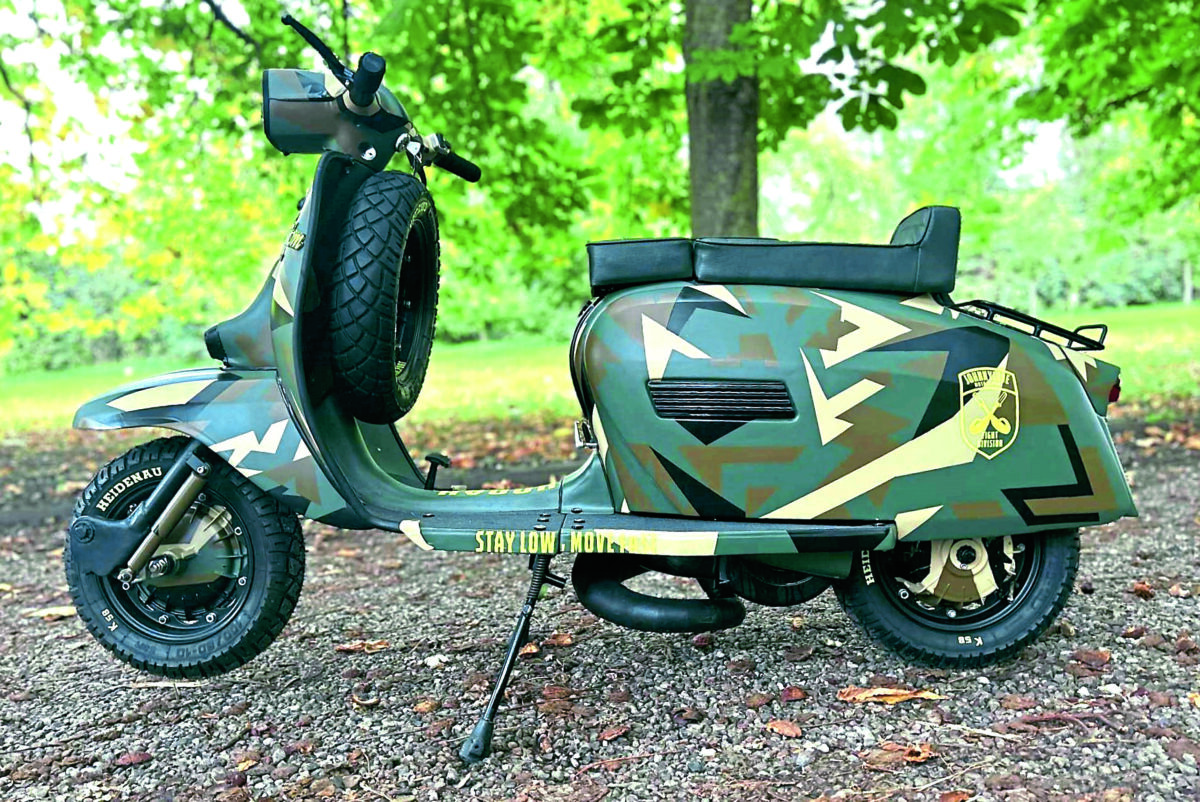
However, it isn’t as easy as it looks because there is a lot of panelwork to consider; therefore, it needs to be bolted together in a dry-build fashion so the design layout can be configured. He then used what is described as digital camouflage, where a computer program takes a pattern and overlays it. Once that was done, it was then transposed onto the panels using different colours. They would be black, pale yellow, olive, and dark green, and were done using aerosol cans (Again, we are seeing this old technique used even more). It would be a painstakingly slow process because it isn’t like the old-fashioned curved line design we all remember. The modern approach often uses jagged straight lines, often in a zigzag style.
Starting with dark green as the base was the correct choice, but then every other colour would be overlaid on top. Each time, a different colour would require its area masked before being sprayed onto the surface. It may look like a simple idea, spraying different shapes onto each bit of bodywork, but the truth is, it was challenging. Maddin would often post his progress: “Another panel or bit of bodywork completed today”, as each piece was slowly completed. At times, he needed a rest, a break from it, because the work was so demanding and time-consuming. Not forgetting an almost colour-blind effect, so intense was the staring at it for hours at a time.

Blackout
When it comes to the engine in a custom build, it’s often the most bling-looking part. The magpie’s nest of bright, shiny bits becomes the centrepiece of modern high-tech tuning goodies. There is nothing wrong with that philosophy, that is, unless you are building some military-esque machine. When was the last time you saw a tank with a great big, fancy-looking engine on display? The answer is … never, because it’s hidden away as it should be, so the same needed to happen on this build. You can’t enclose the engine in its entirety, even though Innocenti did a pretty good job of doing so, but a chrome sidecase and expansion pipe don’t quite fit here.

The easy solution was to matt-black the casings and ensure nothing was brightly polished. Everything from the cowlings to the fixings have all utilised the same colour, allowing them to blend in perfectly with the paint scheme. Items such as the exhaust and cables come in black anyway, but others, such as the kickstart, for instance, don’t. Maddin was careful to make it all appear the same and create that stealthy look, but that didn’t mean the engine power had to be as subdued.
It is fitted with an RB 20 small-block cylinder, remember them, and by using a SIP performance 60/116 crankshaft, it pushes the capacity up to 205cc. Combined with the AF Tornado expansion pipe and a Polini 34mm flat-slide carburettor, it delivers a healthy kick of performance, certainly for a small-block casing.
To get power to the rear wheel, the Liedolsheim V2.0 clutch delivers it to the gearbox. Talking of which, it is a Pacemaker (Why didn’t Innocenti fit that to all their models?) using a 17/46 sprocket combination. A 4.98 drive in 4th gear means that at 8000 rpm, it is pushing around 80mph, and the close spacing of the gear ratios means it has no problem getting there.

Hardware
Anything based on a military design is often basic but robustly built and hard-wearing. That doesn’t mean to say this build is basic, far from it, but it was never going to be covered in chrome or fancy finishes because it wouldn’t look right. The floor runners have been removed and replaced with much more durable grip tape. The seat is a dual Snetterton cover in a green finish and looks far more durable than the standard equivalent. The traditional pencil dampers remain, and it’s still using the drum brake setup rather than a fancy outboard disc brake, akin to a Moto GP bike.
The look is enhanced by all the chrome and aluminium replaced by satin black, including the lever control headlamp rim and rear rack. It’s only as you look at it more that you see the finer detail that has gone into it.
The finishing touch is the addition of the heavy-duty Heidenau tyres, which make you think this is a combat vehicle ready for action. It also goes to show that, when you put your mind to it, the Lambretta is versatile enough to be transformed into something completely different.
Maddin is one of those people who create unique, outlandish designs for Lambrettas. At first glance, this machine may look pretty straightforward, but when you see the time and effort he has put into it, you realise it’s an outstanding piece of work. Let’s hope he continues to build them because they are exciting and a breath of fresh air.

Profile
Scooter club & town
Kelten RollerClub Ostholstein
First interest in scooters
It started at soccer, age 14, when one of the older lads came to the training with a loud rat-look street racer Vespa PX. From that point on, I was lost – no money left over for girlfriends, alcohol or drugs LOL.
Favourite scooter model
Lambretta GP and Vespa Sprint
Favourite style of custom scooter
From my point of view, there is no need for a special style. It doesn’t matter if it’s a cutdown, a skelly, a full-body, a chopper, or a racer… everything which is special and individual is great.
Furthest you’ve ever ridden on a scooter
From the north of Germany to Mersea Island

Engine specification
Kit
AF RB 20
Crank
Long Stroke Crankshaft SIP PERFORMANCE 60/116
Carb
Polini 34mm flatslide
Exhaust
AF Rayspeed
Clutch
Liedolsheim V2.0
Gearbox
Pacemaker 150 on 46/17 sprockets
Article originally appeared in Scootering Magazine Feb 26. To subscribe and some Meguiars cleaning freebies visit https://classicmagazines.co.uk/scootering?offer=SCOME2026